
The Battle of Vertières, Haitian Identity, and FIFA’s Jersey Ban: History, Memory, and Global Recognition
- Guerrier Aluc, Carlo

- 10 hours ago
- 4 min read
On November 18, 1803, the Battle of Vertières became the decisive military victory that secured Haiti’s independence and changed world history. Led by Haitian revolutionary forces under General Jean-Jacques Dessalines and heroes such as François Capois, the battle defeated Napoleon Bonaparte’s army and ended French colonial rule in Saint-Domingue. Within weeks, Haiti would declare independence on January 1, 1804, becoming the first Black republic in the modern world and the only nation founded through a successful slave revolution. (Wikipedia)
For Haitians, Vertières is not merely a military engagement. It is the nation’s founding moment. It symbolizes freedom, self-determination, resistance to slavery, and the triumph of a people whom the colonial powers believed could never govern themselves. The battle represents the culmination of a revolutionary struggle that began with enslaved Africans refusing to accept bondage and demanding the universal application of the principles of liberty and equality. (Haitian Art Society)
The significance of Vertières extends far beyond Haiti. For Africans and people of African descent throughout the world, the Haitian Revolution demonstrated that slavery was neither inevitable nor permanent. At a time when European powers and slaveholding societies justified racial oppression through claims of Black inferiority, Haiti delivered a powerful rebuttal on the battlefield. The victory inspired enslaved and colonized peoples across the Americas, the Caribbean, and Africa. It challenged the foundations of the Atlantic slave system and forced colonial powers to confront the reality that enslaved Africans could organize, fight, and win against one of Europe’s greatest military powers. (Haitian Art Society)
For many scholars, Haiti’s independence marked one of the most important events in the global struggle for human rights. Yet the revolution was often minimized, ignored, or treated as an uncomfortable chapter in Western historical narratives. Unlike the American and French Revolutions, the Haitian Revolution received comparatively little recognition in international institutions, textbooks, and popular culture despite its profound impact on world history. (Chron)

This historical context helps explain the emotional response to FIFA’s recent decision regarding Haiti’s 2026 World Cup jersey. The original jersey included imagery inspired by the Battle of Vertières and Haiti’s independence heroes. FIFA ruled that the design violated regulations prohibiting political, religious, or personal messages on uniforms and required the Haitian team to remove the artwork before the tournament. FIFA classified the imagery as potentially political despite the manufacturer and Haitian football officials arguing that it was intended as a tribute to national history and cultural pride. (The Guardian)
For many Haitians, the decision was deeply disappointing because the imagery was not promoting a contemporary political movement or partisan cause. Instead, it commemorated the founding struggle of the Haitian nation. Critics argued that depicting the Battle of Vertières is analogous to other countries celebrating their wars of independence, national heroes, or founding historical moments. The controversy therefore became larger than a uniform dispute; it raised questions about who gets to define the boundary between history, culture, and politics. (The Guardian)

The reaction among Haitians and members of the diaspora reflected this sentiment. Many viewed the jersey as an opportunity to educate the world about Haiti’s revolutionary legacy and to celebrate a defining chapter in Black history on one of the largest sporting stages. Discussions within Haitian communities frequently centered on the belief that Vertières is a cultural and historical symbol rather than a political slogan. (The New Yorker)
Was There a Precedent for FIFA’s Decision?
Yes, FIFA has a long-standing policy prohibiting political, religious, and personal statements on equipment and uniforms. The organization has previously restricted messages, symbols, and displays that it determined could be interpreted as political. The rule itself is not new. (Talksport)
However, the Haiti case is unusual because the disputed imagery referred to a historical event that serves as the foundation of the nation itself. The controversy therefore differs from cases involving contemporary political campaigns, election messages, territorial disputes, or current geopolitical conflicts. Critics have argued that FIFA’s application of the rule effectively categorized Haiti’s independence struggle as a political statement rather than a historical and cultural commemoration. (The Guardian)
There are precedents for governing bodies restricting national symbols or historical references when they believe those symbols carry political implications. Yet there are relatively few examples involving a country’s foundational independence battle being removed from a national team uniform at a World Cup. This is one reason the Haiti case generated significant international discussion and criticism. (The Guardian)
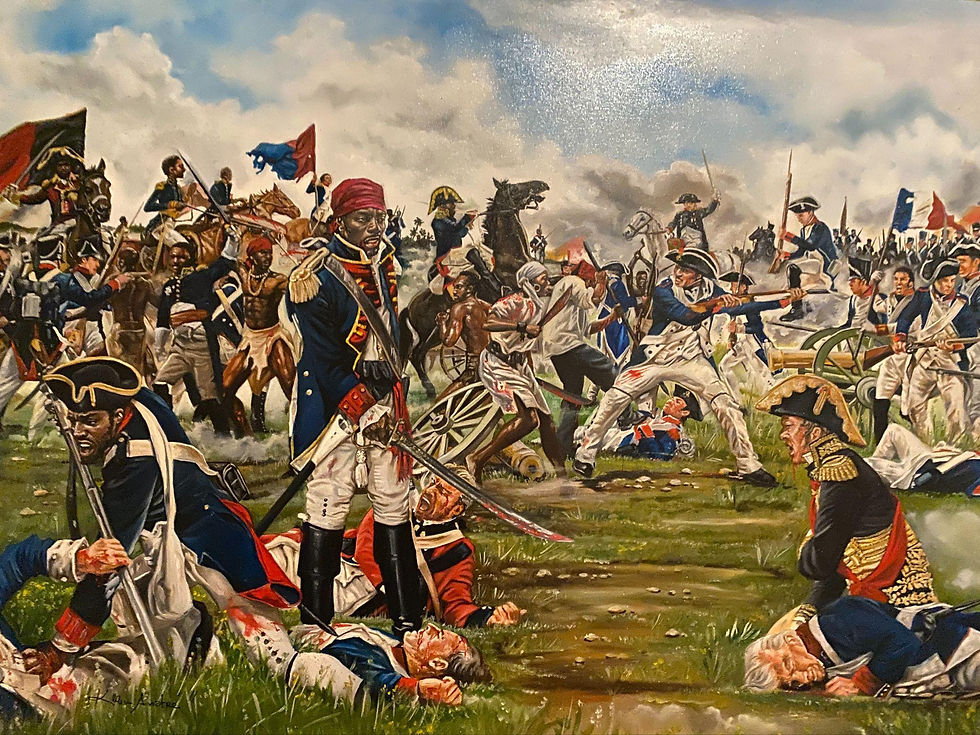
In conclusion, the Battle of Vertières remains one of the most consequential victories in modern history. It secured Haiti’s independence, created the world’s first Black republic, and offered hope to oppressed peoples across the globe. For Haitians and many throughout the African diaspora, Vertières symbolizes courage, dignity, and the universal right to freedom.
The FIFA jersey controversy demonstrates that the legacy of the Haitian Revolution remains contested more than two centuries later. Whether viewed as a straightforward application of FIFA regulations or as an example of international institutions misunderstanding Haiti’s historical experience, the debate reveals the enduring power of Vertières. The battle continues to shape questions of identity, recognition, memory, and historical justice—not only in Haiti, but throughout the African world.


Comments