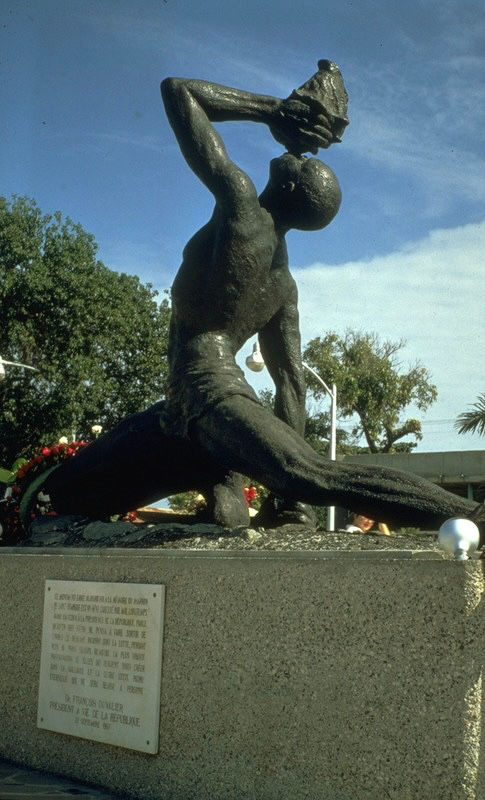
What We Have Made of Your Freedom, Haiti

It has been nearly half a century since I left Haiti. But Haiti has never left me. She lives in my language, in my memory, in silences that never learn how to lie. I built a life elsewhere. My identity did not move an inch. That fidelity is precisely what makes the pain so deep and it is not mine alone.
Haiti was born of a revolution the world had not thought possible: enslaved men and women who broke their chains through the sheer force of their dignity. In 1804, while Europe still traded in human beings, Haiti stood up and said, We are free. That birth should have been an eternal testament. Instead it became a weight we did not know how to carry.
What we see today is not fate, and it is not the curse some invoke with the convenient condescension of people who have always believed the poor deserve their suffering. It is the predictable outcome of decades of deliberate betrayal and today that betrayal wears a new face.
Right now, more than 300,000 Haitians in the United States are staring down the loss of everything they built: Temporary Protected Status, revoked, their work permits gone, ICE vans idling at the edge of communities that have known nothing but sacrifice and remittance. Meanwhile, across the border, the Dominican Republic deports Haitians by the truckload, day after day, at a pace of roughly a thousand people every twenty-four hours mothers, laborers, children, shackled and shipped back to a homeland that has no roads to receive them, no camps ready, no jobs waiting, no safety at all. Two nations, two hemispheres, one verdict: Haitian lives are disposable.

And what does the Haitian government do with this unfolding catastrophe? It talks about elections. It debates calendars and candidate lists while buses of the deported unload at the border with nothing but the clothes on their backs. It negotiates seats while gangs negotiate territory. Somewhere, a minister is rehearsing a speech about democratic renewal while a mother in Kenscoff boils water she cannot make clean and a father in Port-au-Prince decides which street is safe enough to risk today. This is not governance. It is theater performed over a mass grave, and the people are expected to applaud.
Too many leaders have treated power as plunder. Impunity is not a Haitian accident; it is architecture, built brick by brick by those who benefit when nothing changes. Corruption did not take root in spite of the elites it took root with them, through them, for them. And those of us who watched from a distance, who sent remittances, who came home for vacation and left again with an easy conscience, have accounts to settle too.
The diaspora carries a share of that responsibility, and it must be named without flinching. We have brought home our diplomas without leaving behind our skills. We have produced more opinions than commitment myself included. Helping Haiti demands more than good intentions. It demands rigor, consistency, and a refusal to compromise that we have not always held ourselves to.
I dream of a Haiti where the law applies to the general and the laborer alike, to the minister and the unknown citizen. Where a child born in the hills of the Artibonite is not condemned to darkness by the accident of birth. Where hospitals heal instead of burying the dead for lack of medicine, staff, or light. Where the young no longer have to choose between exile and despair and where exile itself is no longer a life sentence handed down by a foreign court or a border checkpoint.
This dream is not naive; it is demanding precisely because it is clear-eyed. It calls for painful breaks with habits grown comfortable and impunities grown hereditary. It calls for ordinary leaders carrying an extraordinary ethic, and a people who refuse to keep applauding what deserves condemnation. Progress will come slowly, through relapse and resurrection, through lost illusions and recovered convictions. But I have watched this people lift its head after the 2010 earthquake and after massacre upon massacre, keep its humor amid the rubble, keep its dignity intact beneath the ruins. A people capable of such endurance is capable of such rebirth.
Haiti is not lost. She is in waiting, suspended between the promise of 1804 and the tragedy of 2026 between ash and ember. And I, at nearly half a century's distance, still hear beneath the crack of gunfire, beneath the weeping of the displaced and the deported, beneath the silence of overcrowded cemeteries, the beating of her heart. Slow. Wounded. But alive.
Haiti is not only a land I left. She is a promise I have never stopped carrying, a debt I will never finish honoring, a light that even in the darkest nights I refuse stubbornly and fiercely to watch go out.
And despite everything, I believe in her still.
Pierre-Richard Raymond
August 13, 2026
Culture509


❤️