Haiti Cherie: How Did We Get Here?
- Guerrier Aluc, Carlo
- 1 hour ago
- 3 min read
Haiti was once known as the Jewel of the Antilles. Today, it is known as the poorest nation in the Western Hemisphere. For those of us who lived through both eras, that transformation is heartbreaking.
I was born in the 1970s and spent my childhood under the government of Jean-Claude “Baby Doc” Duvalier. History rightly records his regime as a dictatorship responsible for serious human rights abuses. Many Haitians were imprisoned, tortured, forced into exile, or killed. Their suffering should never be forgotten or minimized. The relative calm some of us remember was inseparable from fear, censorship, and repression.
At the same time, my childhood memories are real, too.
I remember clean streets, functioning public services, electricity, running water, and telephones in Port-au-Prince and other major cities. I remember neighborhoods where families felt safe enough to let their children travel alone, even though that safety existed within an authoritarian system that punished dissent.
As a young boy, I would take a tap-tap from Delmas to Fontamara to visit my godmother and return home without incident. My mother trusted that I would make it home safely. That simple freedom feels harder to imagine today, though it existed alongside a political climate of fear.


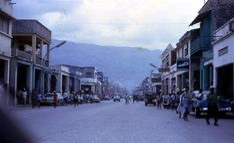
Downtown Port-au-Prince was alive. Jewelry stores proudly displayed expensive merchandise behind glass windows. Tailors, couturiers, restaurants, hotels, and banks welcomed customers, even as the regime kept a tight grip on political life. Tourists walked the streets. Businesses invested because they believed in tomorrow, though that tomorrow was shadowed by repression.
I also remember a justice system that appeared to function. Police patrolled the streets. Courts operated. One memory has stayed with me for decades: prisoners walking past my house, escorted by only two guards as they returned to the National Penitentiary after performing community service. Whether the system was fair or humane is another question, but there was a visible order, maintained in a country where the state also used intimidation and violence to preserve control.
Then came the fall of the Duvalier government in 1986. Haitians hoped democracy would bring greater freedom, stronger institutions, and broader prosperity. Those hopes were genuine, and they were shared across the country.
Instead, the decades that followed brought repeated political crises, coups, corruption, weak institutions, natural disasters, foreign intervention, economic collapse, and the steady rise of armed gangs. No single event or government bears sole responsibility. Rather, Haiti has endured a succession of failures that have eroded the authority of the state and the confidence of its people.
The greatest victims have been our children.
Before 1986, I do not remember seeing bodies lying in the streets. Today, many Haitian children have grown up surrounded by violence. They have witnessed killings, kidnappings, burned neighborhoods, and families fleeing their homes. Many have become desensitized to horrors that no child should ever experience.
My generation also grew up surrounded by culture.
Port-au-Prince had more than thirty movie theaters. Plays were performed throughout the city. Sports brought communities together. Basketball, soccer, and volleyball flourished at schools like Collège Saint-Pierre, Canado, and Collège Saint-Martial. Libraries and cultural institutions nurtured curiosity, creativity, and hope.


Today, much of that cultural life has faded. Movie theaters have closed. Sports facilities such as Centre Dadadou and Centre Sportif de Carrefour have fallen into disrepair or ceased operating. Libraries struggle to survive. Many cultural institutions that once inspired young minds barely exist.
When a nation cannot educate its youth, entertain them, protect them, or employ them, it should not be surprised when many see only two paths forward: leave the country or join the gangs or those who control it through violence.
Our young people deserve better.
They deserve schools that open every morning without fear. They deserve libraries filled with books, sports fields filled with laughter, and neighborhoods where parents no longer worry whether their children will return home safely.

Haiti’s future cannot be built on nostalgia, nor can it be built by ignoring the lessons of history. We must acknowledge both the repression of the past and the failures of the present. Freedom without security is fragile. Security without freedom is incomplete. A nation needs both.
I still believe Haiti can become the Jewel of the Antilles once again, not by returning to the past, but by building a future founded on justice, security, opportunity, and accountable leadership.
I never imagined that the Haiti of my childhood would become the Haiti of today.
I still ask myself, and I ask all Haitians:
How did we get here?
Carlo Aluc, MCJ
Culture509